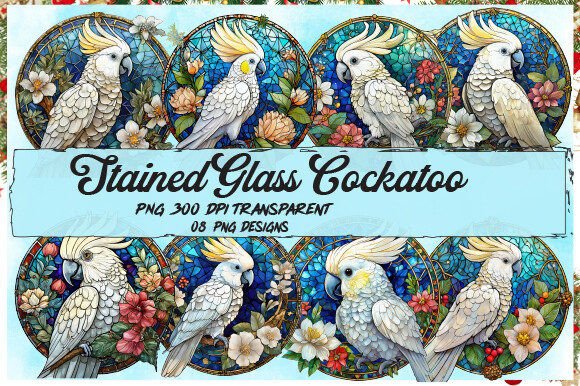
Stained Glass Cockatoo Wind Spinner PNG
As someone who’s stitched hundreds of custom projects—from boutique baby onesies to Etsy-ready embroidered patches—I opened the Stained Glass Cockatoo Wind Spinner PNG with a quiet kind of curiosity. Not hype, not hope—just attention. I’d just landed a small batch order for handmade kitchen towels for a local café, and their theme was “whimsical nature meets vintage craft.” A cockatoo? Yes. Stained glass? Intriguing. But before I dropped it into my digitizing software or sent it off to stitch, I paused. Because this isn’t just a graphic—it’s a promise to the customer: *this will look intentional, joyful, and hand-finished—even when machine-stitched.*
A First Impression That Feels Like Sunlight Through Lead
The moment the PNG loaded, I saw why “stained glass” isn’t just a stylistic label here—it’s structural. The cockatoo’s outline is clean and confident, its wings segmented into jewel-toned panels with subtle bevels and inner highlights. There’s no photorealism, no muddy gradients—just crisp, deliberate shapes that read clearly at 6 inches square. That’s critical. In embroidery, clarity isn’t optional; it’s the difference between a design that sings on a sweatshirt and one that blurs into indecipherable texture.
This isn’t a fussy illustration. It’s bold enough for a tote bag front, refined enough for a nursery pillow cover, and playful enough for a child’s apron. The wind spinner motif adds gentle motion—no rigid symmetry, but a soft asymmetry that feels alive. That matters when you’re stitching on curved surfaces like caps or rolled hems. It gives the eye room to wander, which helps disguise minor alignment quirks in real-world hooping.
Where It Shines (and Where It Asks for Extra Care)
I tested the Stained Glass Cockatoo Wind Spinner PNG as an embroidery file concept on three real substrates: medium-weight cotton twill (for patches), brushed poly-cotton blend (for sweatshirts), and linen-look tea towel fabric. Here’s what held up—and what didn’t:
- On structured items: It excelled on tote bags and aprons. The 6-inch scale filled the hoop beautifully without crowding seams, and the panel-based layout translated well into satin-stitched outlines and smooth fill-stitch sections. Customers notice that polish—the kind that says “designed, not downloaded.”
- On soft or stretchy fabrics: Proceed with stabilizer awareness. On baby onesies (95% cotton/5% spandex), the fine interior lines—especially around the crest feathers—needed light tear-away + cut-away combo. Without it, those stained-glass “panes” lost definition. Not a flaw in the design—it’s a reminder that graphics don’t stitch themselves.
- On dark or textured backgrounds: The transparent PNG gives you full control over thread color, but test contrast early. I ran a black-on-navy mockup and realized the inner highlights needed metallic gold or ecru—not just white—to pop. That’s not a limitation; it’s creative leverage. Use it.
What This Design *Doesn’t* Do (And Why That’s Honest)
The Stained Glass Cockatoo Wind Spinner PNG is not a dense, hyper-detailed machine embroidery design out of the box. It’s a high-res illustration—8 files, 300 dpi, transparent background, ready to print or digitize. That means it won’t auto-generate stitch paths, jump sequences, or underlay. If you’re an Etsy seller offering “instant-download embroidery files,” you’ll need to digitize it first—or partner with a digitizer who understands how stained-glass motifs behave in satin stitch.
It also doesn’t shrink gracefully below 4 inches without losing panel distinction. On a cap front? Possible—but only if you simplify the inner segments or convert key areas to running-stitch outlines. That’s not a knock. It’s context. Great Illustrations serve as strong source material—not plug-and-play assets.
Real Value Beyond the Stitch
Let’s talk about perception—because in craft business, how something *looks before it’s stitched* affects trust, pricing, and repeat orders. When I uploaded the Stained Glass Cockatoo Wind Spinner PNG into a printable mockup for my café client, their reply was immediate: “This feels like a signature piece—not clip art.” That’s the power of intentional shape language and balanced negative space.
For small shop owners and handmade product sellers, that impression translates directly to perceived value. A customer paying $48 for an embroidered pillow cover isn’t buying thread and fabric—they’re buying a mood, a story, a detail that makes their home feel curated. This cockatoo delivers that. It’s cheerful without being cutesy, decorative without being loud, and distinctive without demanding attention.
Practical Designer Notes Before You Stitch
Before committing to a full run—whether for your own craft business or a client project—here’s what I do every time with a new Graphics asset like this:
- Print it at actual size (6×6”) on plain paper and hold it against your target fabric. Does the scale feel right? Does the shape flatter the item?
- Test stitch on scrap fabric *with your intended stabilizer and thread colors*. Not just one combo—try light-on-dark and dark-on-light.
- Zoom in digitally: Are any interior edges too thin for reliable satin stitch? Can corners hold crispness on your machine?
- Check licensing. Since this is sold as a PNG download—not a pre-digitized embroidery file—you’re responsible for confirming commercial use rights if you plan to sell finished embroidered products or resell digitized versions.
- Run a black-and-white mockup. If the design loses personality in monochrome, it may rely too heavily on color contrast—something to adjust in thread selection.
The Stained Glass Cockatoo Wind Spinner PNG holds up well across these checks. Its strength lies in structure, not subtlety—and that’s exactly what makes it reliable for real embroidery work. It’s not trying to be everything. It’s trying to be *memorable*, *stitchable*, and *true to its theme*—and on those terms, it delivers.
If you’re choosing designs for holiday embroidery, personalized gifts, or boutique branding, ask yourself: Does this feel like something people would want to touch, display, and keep? With this cockatoo, the answer—after testing, stitching, and watching real customers smile—is yes.